Posts

Showing posts with the label Albert Einstein

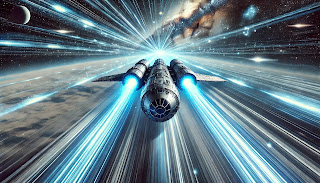
Light Speed vs. Thought Speed — When the Mind Races the Cosmos

Image
“We are not limited by the speed of light. We are limited by the speed of thought.” — Aurora’s Log, Entry 192: Event Horizon of Consciousness In the yawning void between galaxies, we send photons skipping across space—tiny packets of energy that obey a strict, cosmic speed limit: 299,792,458 meters per second . It is the universal cruise control. No matter how advanced our propulsion, light remains the benchmark against which all motion is measured. But the human mind? The soul of a being? The flash of a memory or a dream? It gets there first. Always. Welcome to the standoff between light speed and thought speed —a collision of physics and cognition, photons and neurons, Einstein and introspection. Thought Speed: What Actually Moves in the Brain? When we say “speed of thought,” we’re not talking about something measurable in meters per second—at least, not easily. Here's what really happens under the hood of consciousness: 1. Neural Transmission Our brain communicates t...

If You Can Imagine It, It Exists: The Science of Possibility

Image
The Mind of the Cosmos: Why Nothing Imagined Is Truly Impossible By webeater |A Dreamer of Multiverses and Timewalkers Introduction: The Power of the Mind From the first spark of thought to the last whisper of dream, the human mind has wandered beyond the boundaries of flesh and gravity. We dream of flight, time machines, alien cities, and otherworldly realms. But what if this isn’t fantasy? What if this is the blueprint of what is—or will be—real? There is a deep, unshakable principle buried in the very mechanism of imagination: The mind cannot think the truly impossible. This is not just poetic—it is scientific, neurological, and cosmological. 1. The Mind Cannot Draw What Cannot Be Imagination is often seen as a creative force, but beneath its mystery is a pattern. Our brains, governed by neurons and physics, cannot conjure something that has no basis in possibility. Every image we visualize, even the wildest ones, is assembled from fragments of reality—past, present, or p...

Why Can’t We See an Object Moving at the Speed of Light?

Image
Have you ever wondered what would happen if something moved at the speed of light? Would we be able to see it streaking across the sky like a shooting star? The short answer is no —and the reason has to do with the very nature of light, time, and the laws of physics. Let’s break it down into simple ideas. 1. Light is the Fastest Thing in the Universe Light travels at an incredible speed— about 299,792 kilometers per second (186,282 miles per second) in a vacuum. That’s so fast that light from the Moon takes only about 1.3 seconds to reach Earth. No physical object with mass can ever reach or exceed this speed because of the laws of physics discovered by Albert Einstein.