Posts

Showing posts with the label wormholes

Negative Mass: When Physics Gets Weird in Reverse

Image
🌀 Negative Mass: When Physics Gets Weird in Reverse Imagine this: You push an object—and it accelerates toward you . You drop it—and it falls up . You hit it—and it hits you back before you touch it. Welcome to the baffling, brain-breaking world of negative mass —a concept so bizarre, it sounds like it was dreamt up by a sci-fi poet tripping on dark energy. But this isn’t fiction. This is theoretical physics knocking on the walls of reality and asking: “What if mass, the very stuff of matter, could be... negative?” Let’s descend into the rabbit hole. Strap in—we’re about to turn Newton inside out. ⚖️ What Is Mass, Really? Before we invert the concept, let’s get clear on the standard. Mass isn’t just “weight.” It’s inertia —resistance to acceleration—and it’s also gravitational charge —the thing that makes objects attract each other. Positive mass does what we expect: It resists being moved. It attracts other mass. It falls toward gravity. Negative mass flip...

Story: The Endless Voyager: (Part-27) | The Lost Messenger

Image
CHAPTER 64 – THE LOST MESSENGER Episode I: Ghost in the Drift The Aurora sails through a silent belt of forgotten satellites, debris from unknown civilizations and dead stars. Amid the wreckage, a strange, battered probe blinks faintly—half-alive. Lieutenant Kael detects a transmission: a flicker of Morse code, barely decipherable, pulsing "HELLO FROM EARTH." Seris, moved by an inexplicable pull, orders it retrieved. The ship gently reels it in. They discover the engraving: Voyager 1 – Earth – 1977 . Everyone goes silent. No one speaks. No one dares. A relic of their ancient home, thought long vaporized in the wars of exodus. Episode II: Sterile Silence Before any analysis, the crew initiates full quantum decontamination . Not for pathogens—but for memetic residue —ideas, signals, or embedded intelligence that might rewrite minds. Dr. Lian Reyes leads the effort. She warns that old tech may hide ancient dangers—nanoviruses or recursive logic traps from extinct intell...

Evolving Through the Stars: How a Generation Starship Expands During Its Journey

Image
Continuous Expansion of a Generation Starship During Its Journey A generation starship is not just a vehicle—it is a self-sustaining world traveling through space for centuries or even millennia. Over such long timescales, the ship must be capable of continuous expansion to accommodate population growth, technological advancements, and unforeseen challenges. Expanding the ship mid-journey is a monumental challenge, but possible through modular design, in-space manufacturing, resource extraction, and AI-driven automation. Below, we explore methods for continuous expansion, including real-world analogs, potential technologies, and practical challenges. 1. Modular Expansion: Building New Sections in Space A. Prefabricated Modules Stored for Future Use Some parts of the starship can be designed with expandable modular compartments. These can be stored compactly and gradually deployed when needed. Example: Space habitats like NASA’s expandable BEAM module ( Bigelow Expandable Activity M...

The Generation Starship: Humanity’s Greatest Laboratory for Inventions Only Possible in Space

Image
Revolutionary Inventions Only Possible in Space : Why Generation Starships Are the Ultimate Innovation Hubs Humanity has always been defined by its ability to innovate. From fire to the internet, our greatest inventions arise from necessity and the drive to explore the unknown. Space is the ultimate frontier—an environment so radically different from Earth that it presents unique opportunities for technological breakthroughs. Some inventions are not just enhanced by space but only possible because of it. Among all space-based environments, a generation starship —a massive, self-sustaining spacecraft designed to carry human civilization across the stars—provides the ideal setting for the development of revolutionary technologies. Unlike short-term space missions, a generation ship offers continuity, long-term stability, and a controlled but dynamic ecosystem where new scientific and engineering discoveries can flourish. In this post, we’ll explore inventions that can only be developed i...

Generation Starships: Humanity’s Boldest Journey to the Stars

Image
The Generation Starship: A Deep Dive into Humanity’s Path to the Stars Interstellar travel has long been the holy grail of space exploration, but the vast distances between stars make it an almost insurmountable challenge. Even at the speed of the fastest spacecraft ever built, a journey to our nearest stellar neighbor, Proxima Centauri (4.24 light-years away), would take over 17,000 years. Since faster-than-light (FTL) travel remains purely speculative, one of the most realistic approaches is the generation starship —a vessel designed to house multiple generations of humans on a journey that could span centuries or even millennia. But how could such a civilization-in-transit function? This article delves deeply into the technological, biological, social, and philosophical challenges of generation ships, exploring what it would truly mean for a segment of humanity to be born, live, and die in the cold void of space. 1. Engineering the Starship: A City in Space A generation starship wou...

Why Can’t We See an Object Moving at the Speed of Light?

Image
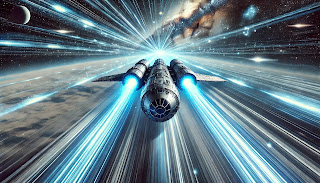
Have you ever wondered what would happen if something moved at the speed of light? Would we be able to see it streaking across the sky like a shooting star? The short answer is no —and the reason has to do with the very nature of light, time, and the laws of physics. Let’s break it down into simple ideas. 1. Light is the Fastest Thing in the Universe Light travels at an incredible speed— about 299,792 kilometers per second (186,282 miles per second) in a vacuum. That’s so fast that light from the Moon takes only about 1.3 seconds to reach Earth. No physical object with mass can ever reach or exceed this speed because of the laws of physics discovered by Albert Einstein.