Posts

Showing posts with the label light speed

Light Speed vs. Thought Speed — When the Mind Races the Cosmos

Image
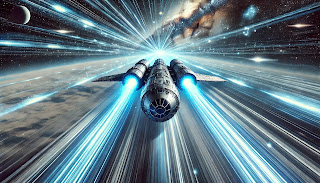
“We are not limited by the speed of light. We are limited by the speed of thought.” — Aurora’s Log, Entry 192: Event Horizon of Consciousness In the yawning void between galaxies, we send photons skipping across space—tiny packets of energy that obey a strict, cosmic speed limit: 299,792,458 meters per second . It is the universal cruise control. No matter how advanced our propulsion, light remains the benchmark against which all motion is measured. But the human mind? The soul of a being? The flash of a memory or a dream? It gets there first. Always. Welcome to the standoff between light speed and thought speed —a collision of physics and cognition, photons and neurons, Einstein and introspection. Thought Speed: What Actually Moves in the Brain? When we say “speed of thought,” we’re not talking about something measurable in meters per second—at least, not easily. Here's what really happens under the hood of consciousness: 1. Neural Transmission Our brain communicates t...

Story: The Endless Voyager: (Part-1) | The Living Ship

Image
The Endless Voyager Prologue: The Living Ship For 954 years , the Aurora had sailed through the dark, expanding like a living organism. Corridors stretched . Walls shifted . Entire city-sized districts grew from its metallic bones. It was a world unto itself, its people living, dying, and being born within its artificial atmosphere, never knowing the truth . They believed they were moving slowly , making their way toward Eden-3 , a lush exoplanet promised to their ancestors. But in reality, the Aurora had been traveling at light speed for nearly a millennium. And now, it was slowing down . As it approached its destination, something unexpected happened. The people locked in cryogenic sleep, thought to be the ship’s forgotten past, began to wake . And below them, Eden-3 shimmered in the starlight. With human cities already glowing on its surface. Chapter 1: Awakening the Lost Cryo-Vault Theta, Year 954 of the Voyage The first thing Dr. Adrian Kade felt was cold . Not the numbing i...

Evolving Through the Stars: How a Generation Starship Expands During Its Journey

Image
Continuous Expansion of a Generation Starship During Its Journey A generation starship is not just a vehicle—it is a self-sustaining world traveling through space for centuries or even millennia. Over such long timescales, the ship must be capable of continuous expansion to accommodate population growth, technological advancements, and unforeseen challenges. Expanding the ship mid-journey is a monumental challenge, but possible through modular design, in-space manufacturing, resource extraction, and AI-driven automation. Below, we explore methods for continuous expansion, including real-world analogs, potential technologies, and practical challenges. 1. Modular Expansion: Building New Sections in Space A. Prefabricated Modules Stored for Future Use Some parts of the starship can be designed with expandable modular compartments. These can be stored compactly and gradually deployed when needed. Example: Space habitats like NASA’s expandable BEAM module ( Bigelow Expandable Activity M...

The Generation Starship: Humanity’s Greatest Laboratory for Inventions Only Possible in Space

Image
Revolutionary Inventions Only Possible in Space : Why Generation Starships Are the Ultimate Innovation Hubs Humanity has always been defined by its ability to innovate. From fire to the internet, our greatest inventions arise from necessity and the drive to explore the unknown. Space is the ultimate frontier—an environment so radically different from Earth that it presents unique opportunities for technological breakthroughs. Some inventions are not just enhanced by space but only possible because of it. Among all space-based environments, a generation starship —a massive, self-sustaining spacecraft designed to carry human civilization across the stars—provides the ideal setting for the development of revolutionary technologies. Unlike short-term space missions, a generation ship offers continuity, long-term stability, and a controlled but dynamic ecosystem where new scientific and engineering discoveries can flourish. In this post, we’ll explore inventions that can only be developed i...

Reclaiming the Stars: How a Lost Generation Starship Can Rediscover Its Mission

Image
Restoring the Mission : How a Generation Starship Can Regain Its Purpose A generation starship is a civilization in motion, a self-contained world carrying the hopes of ancestors toward a distant destination. But if the mission is forgotten, if the people onboard no longer know they are travelers, how can they reclaim their lost purpose? Restoring the mission is not just about rediscovering history—it’s about overcoming societal inertia, repairing failing technology, and guiding an entire civilization toward a destiny they no longer remember. 1. Preventing the Loss of Purpose in the First Place The best solution is to prevent the mission from ever being forgotten. Long-term knowledge preservation is essential to keep the ship on course. A. Building an Unbreakable Chain of Knowledge The mission must be woven into the very fabric of the ship’s society—not just as a story but as an irrefutable fact. Schools should teach children not only how to maintain the ship but why it exists and whe...

Lost in the Void: When a Generation Starship Forgets Its Mission

Image
Forgotten Purpose: When a Generation Starship Loses Its Mission Introduction A generation starship is a marvel of human ambition —a self-sustaining vessel designed to carry multiple generations of people across the void to a distant star. The journey could take centuries, with those who set out never living to see the destination. But what happens if, over time, the original mission is forgotten? If knowledge of the ship's purpose fades into myth, legend, or even complete obscurity? In this article, we’ll explore the psychological, societal, and technological consequences of a lost mission aboard a generation ship. The Gradual Loss of Purpose A generation ship is not just a machine; it's a living society. Knowledge must be passed down through the centuries to ensure the ship stays on course and the population maintains its purpose. However, many factors could lead to the erosion of that knowledge: Cultural Drift : Over generations, language evolves, priorities shift, and record...

Why Can’t We See an Object Moving at the Speed of Light?

Image
Have you ever wondered what would happen if something moved at the speed of light? Would we be able to see it streaking across the sky like a shooting star? The short answer is no —and the reason has to do with the very nature of light, time, and the laws of physics. Let’s break it down into simple ideas. 1. Light is the Fastest Thing in the Universe Light travels at an incredible speed— about 299,792 kilometers per second (186,282 miles per second) in a vacuum. That’s so fast that light from the Moon takes only about 1.3 seconds to reach Earth. No physical object with mass can ever reach or exceed this speed because of the laws of physics discovered by Albert Einstein.